
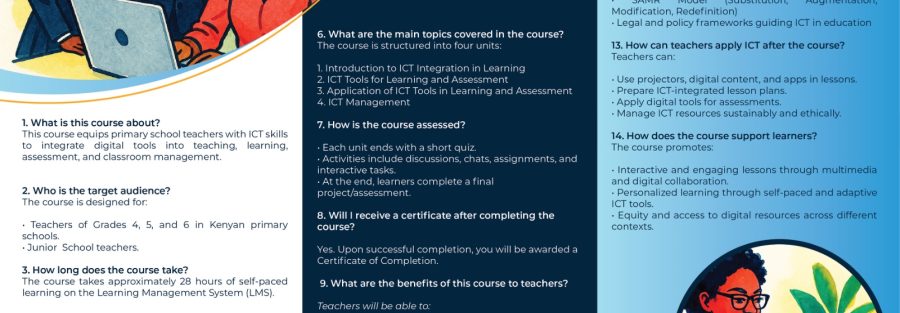
KNATCOM in partnership with the Ministry of Education successfully implemented the UNICEF-funded UKPPL Digital Learning Programme. This is a transformative initiative aimed at enhancing ICT integration in education. It empowers school leaders, teachers, and members of Parent-Teacher Associations (PTAs) and Boards of Management (BoMs) with essential digital skills, while also raising awareness of key education policies.
The programme’s core mission is to improve teaching and learning outcomes in Kenya’s primary schools. By strengthening digital literacy and competencies, it equips educators and learners with the tools they need to thrive in a modern, technology-driven world. The platform is designed to make teaching more effective by saving time, expanding reach, and ensuring equal access for all learners – including those in remote areas and children with special needs.
By integrating ICT into classrooms, learners develop critical thinking, digital competencies, collaborative skills, and other 21st-century skills. These abilities enhance learning outcomes and prepare students to succeed in a knowledge-based society and contribute meaningfully to a modern, innovation-driven economy.
The programme aligns with Kenya’s digitalization agenda, guided by the Kenya National Digital Master Plan 2022–2032, which emphasizes digital literacy and ICT skills in schools. Moreover, it supports UNESCO’s vision for inclusive, quality education, the Sustainable Development Goals (SDG 4 and SDG 10), and regional digital learning initiatives across Africa.
To advance this initiative, a collaborative workshop was held from 25th to 29th August 2025 at Machakos Teachers Training College. Experts and stakeholders from the Ministry of Education (MoE), KNATCOM, and the ICT Authority came together to review the programme and explore practical strategies for integrating ICT into classrooms. This engagement laid the foundation for the pilot rollout.
A two-week pilot phase will be conducted across 13 target counties: Turkana, Samburu, West Pokot, Garissa, Mandera, Wajir, Tana River, Marsabit, Bungoma, Busia, Homa Bay, Kilifi, and Kajiado. It will also include informal settlements in Nairobi. During this period, teachers will engage with the platform both online and in person. Their feedback will help refine the programme before a full-scale rollout. This phased approach ensures the initiative remains responsive to local needs and realities.
KNATCOM continues to champion the ICT Integration in education, reinforcing its commitment to inclusive, engaging, and future-ready education. Through this support, the commission ensures that technology and digital skills are effectively embedded in teaching and learning, giving every child the opportunity to learn, innovate, and succeed.